Source RFID NFC LED Wristband for Festivals, Events, and ID Solutions
Explore 30 listings of RFID NFC LED wristband options featuring passive power, customizable colors, and various chip types. Buyers can compare specifications like reading range, material, and dimensions for applications in festivals, events, and ID solutions.
Key considerations
Products List




Comprehensive Sourcing Guide
Strategic Sourcing Guide for RFID NFC LED Wristbands
Navigating the procurement landscape for RFID, NFC, and LED wristbands requires a disciplined approach that distinguishes between passive identification tools and active illuminated devices. The market presents a diverse array of options ranging from simple fabric tags to complex, battery-powered LED solutions. Buyers must carefully align their specific event requirements, such as music festivals or corporate gatherings, with the technical capabilities of the available inventory. This guide outlines the critical factors for sourcing these products, focusing on the observable attributes, material compositions, and supply chain realities found in current market listings.
Technical Specifications and Material Diversity
The first step in sourcing is understanding the fundamental technical divergence between the product categories. The market offers distinct models based on the intended function, specifically whether the wristband requires a power source or relies on passive technology.
Passive RFID wristbands, often constructed from PVC or PP materials, operate without an internal battery. These devices are designed for identification and data transfer within a short range. Specifications indicate that reading ranges for these passive units typically fall between 1 and 5 centimeters, a figure that is explicitly dependent on the power output of the reader device. The chip type is generally selectable, allowing for Read/Write capabilities which are essential for applications requiring data updates or personalized information storage.
In contrast, active LED wristbands represent a more complex engineering challenge. These devices incorporate a battery, specifically noted as a 2Cr2032 configuration in certain listings, to power the light-emitting diodes. The physical dimensions of these active units vary significantly. For instance, specific models are available in dimensions such as 60mm, 65mm, or 74mm in circumference, while others may feature a size of 15350mm for fabric-based applications. The material composition for these active bands often includes silicone or woven fabrics, offering different tactile experiences and durability profiles.
The following table summarizes the key technical distinctions observed in the current product landscape:
| Feature | Passive RFID/NFC Wristbands | Active LED Wristbands |
|---|---|---|
| Primary Material | PVC, PP, Silicone, Fabric | Silicone, Fabric |
| Power Source | Passive (No Battery) | Active (2*Cr2032 Battery) |
| Chip Capability | Read/Write, Chip Selection Available | Integrated with Power Supply |
| Typical Size | 45mm to 74mm, or 15*350mm | 60mm, 65mm, 74mm |
| Key Function | Identification, Access Control | Illumination, Event Atmosphere |
| Customization | Color, Logo, Encoding | Color, Logo, Light Patterns |
Compliance, Certification, and Standards Verification
When evaluating suppliers, compliance documentation is a critical filter. The provided data confirms that certain products carry ISO certification, which serves as a baseline indicator of quality management systems. However, buyers must exercise caution regarding specific technical standards. While background knowledge often associates RFID technology with standards like IEC 14443 or ISO 15693, these specific standard numbers are not explicitly confirmed in the provided product attributes for every listing.
Therefore, the procurement strategy should focus on verifying the actual certification status of the specific batch being ordered rather than assuming compliance based on general industry knowledge. Buyers should request explicit documentation proving that the RFID chips meet the necessary frequency and protocol requirements for their intended readers. For LED wristbands, the focus shifts to battery safety and electrical standards, though specific certification names are not universally listed in the available product data.
It is imperative to treat the "ISO" mention as an observation of specific listings rather than a universal guarantee for all suppliers. Procurement teams must ask for the certificate of conformity for the specific model number, such as the "Junmp 2525" or "Junmp 2626," to ensure that the claimed standards are met by the actual hardware supplied.
Cost Drivers and Pricing Dynamics
The pricing structure for RFID and LED wristbands is influenced heavily by the complexity of the technology and the level of customization required. The observed price range in the market spans from $0.03 to $7.50 USD. This wide variance reflects the difference between simple passive tags and complex active LED units.
Several factors drive these costs. First, the material composition plays a significant role; silicone and woven fabrics often command different price points compared to standard PVC or PP. Second, the inclusion of a battery and LED circuitry in active wristbands naturally increases the unit cost compared to passive counterparts. Third, customization levels are a major cost driver. While many suppliers offer "Customized" colors and logos, the extent of this customization—such as specific encoding, unique printing, or bespoke packaging—can escalate the price.
The Minimum Order Quantity (MOQ) also impacts the effective unit cost. The observed MOQ range is extensive, spanning from 1 unit to 10,000 units. Buyers seeking small batches for testing or pilot events may find higher per-unit costs due to the lower volume, whereas large-scale orders for music festivals can leverage economies of scale to approach the lower end of the price spectrum. Additionally, the availability of free samples for testing allows buyers to validate quality before committing to large MOQs, mitigating the financial risk of a bulk order.
Typical Applications and Usage Scenarios
The versatility of these wristbands makes them suitable for a broad spectrum of applications. The data explicitly lists usage in bags, shoes, garments, jewelry, luggage, and electronic products, indicating a utility beyond simple event access. However, the most prominent application for the specific "RFID Fabric Wristbands" and "LED Wristbands" is in event management.
Specific use cases include ID solutions for gatherings, parties, and music festivals. The "One-off" usage attribute suggests that many of these products are designed for single-event deployment, where durability over years is less critical than immediate functionality and visual impact. For music festivals, the LED functionality provides a dual purpose: access control and crowd engagement through synchronized lighting.
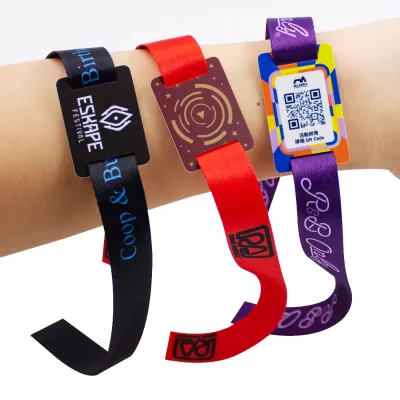
The "Fashionable Make" style and the availability of various colors—ranging from standard white and transparent to red, blue, black, purple, orange, and yellow—allow organizers to align the wristband aesthetics with their brand identity. The ability to encode and print on these bands further enhances their utility for VIP access, cashless payment systems, or personalized identification.
Supplier Evaluation and Origin Analysis
Evaluating suppliers requires a focus on their geographical origins and production capabilities. The data indicates that products originate from specific manufacturing hubs in China, including Ningbo, Wuhan (Hubei), and Guangdong. These regions are known for their electronics and textile manufacturing clusters, which can influence lead times and logistics.
When assessing a supplier, buyers should verify the "prod_origin" details against their logistical requirements. For instance, a supplier in Ningbo may offer different shipping advantages compared to one in Guangdong. The "place_of_origin" is a critical data point for calculating import duties and estimating transit times.
Furthermore, the brand name "DUBAND" appears in the listings, suggesting that some suppliers operate under specific brand identities. However, buyers should not rely solely on brand recognition. Instead, they should evaluate the supplier's ability to handle customization requests. The "Customized" attribute and "Available" customization options indicate that many suppliers are flexible, but the buyer must confirm the feasibility of specific requests, such as unique dimensions or specialized chip encoding, before placing an order.
Quality Control and Packaging Standards
Quality control in this sector hinges on the consistency of the chip performance and the durability of the physical band. The "Standard Export Paper Box" and "in Box" packaging options suggest that suppliers are aware of the need for protection during transit. However, the specific packing configurations vary; some models are packed as 2000 pieces per roll, while others use standard boxes.
Buyers must establish clear quality acceptance criteria. For passive RFID bands, the primary concern is the reliability of the read/write function across the entire batch. For LED wristbands, the battery life and the consistency of the light emission are paramount. The "Free for Testing" sample policy is a valuable tool for quality assurance, allowing buyers to physically inspect the product for defects, verify the battery installation, and test the reading range with their own equipment.
It is also essential to verify the "prod_packing" details to ensure that the packaging protects the products from moisture and physical damage, especially for silicone and fabric bands which may be sensitive to environmental conditions. The "Accept Customized Logo" feature should be tested for print quality and adhesion, as poor printing can lead to customer dissatisfaction at the event.
Long-Term Procurement Considerations
Sourcing RFID and LED wristbands is not merely a transactional purchase but a strategic decision that impacts the success of an event or product line. Buyers should consider the scalability of the supplier. The ability to handle orders ranging from 1 to 10,000 units indicates flexibility, but the lead times associated with these volumes must be confirmed.
Long-term considerations also include the obsolescence of the technology. As RFID standards evolve, ensuring that the chips used are compatible with future readers is crucial. While the current data confirms "Read/Write" capabilities, buyers should inquire about the chip's longevity and the supplier's ability to source compatible replacements if the technology changes.
Additionally, the environmental impact of the materials used, such as PVC or silicone, is becoming a significant factor for many organizations. Buyers should investigate the recyclability of the wristbands and the sustainability of the packaging materials. The "Customized" nature of the products allows for the integration of eco-friendly materials, but this must be explicitly requested and verified during the sourcing process.
In conclusion, successful procurement of RFID NFC LED wristbands requires a balance of technical verification, supplier due diligence, and clear communication of customization needs. By leveraging the available data on specifications, origins, and capabilities, buyers can make informed decisions that ensure high-quality outcomes for their specific applications.
FAQs
Can I get free samples for testing before ordering?
Yes, free samples are available for testing purposes. This allows buyers to verify product quality and functionality before committing to a bulk order, mitigating financial risk for pilot events or small batches.
What materials are used for these wristbands?
The wristbands are constructed from materials such as PVC, PP, silicone, and fabric. The specific material choice depends on the model, with passive tags often using PVC or PP and active LED bands frequently utilizing silicone.
Which customization options are available for the product?
Customization is available for color, logo printing, encoding, and dimensions. Buyers can select from various colors like white or transparent, and request specific sizes such as 60mm or 74mm depending on the model requirements.
How does the power supply mode differ between models?
Passive models operate without a battery, while active LED models use a 2*Cr2032 battery configuration. The passive units rely on reader power for a 1-5cm range, whereas active units provide illumination and require battery management.
What is the typical reading range for passive RFID wristbands?
The reading range typically falls between 1 and 5 centimeters. This distance is dependent on the power output of the reader device used during the scanning process, varying based on the specific reader hardware employed.
Can the chips be chosen for specific read and write functions?
Yes, the chip type can be chosen to support read and write capabilities. This flexibility allows for data updates and personalized information storage, making the wristbands suitable for access control and cashless payment systems.
What are the standard packaging options for these items?
Packaging options include standard export paper boxes or rolls containing 2000 pieces. Some models are packed individually in boxes, ensuring protection during transit while accommodating different order volumes and logistical needs.